COMMA is the Center on Modern Culture, Materialism, and Aesthetics. Operating out of the English Department at the University of California, Santa Barbara, this center considers 20th and 21st century literature through the lens of materialist and critical theory. Our methodologies and theoretical interests are diverse, including: the intersection of Marxist and new materialism, feminist and queer studies, postcolonial theory, ecocriticism, affect studies, and biopolitics. Each year we sponsor conferences, guest speakers, and a reading group that brings together faculty, graduates, and undergrads. We also offer an undergraduate specialization through the English major at UCSB. You can read more about us here.

COMMA Talk 2022-23
Friday, May 26, 3:00–5:00 p.m.
The Sankey Room, South Hall (second floor)
We invite you to a talk: Professor Caren Irr (Brandeis University):
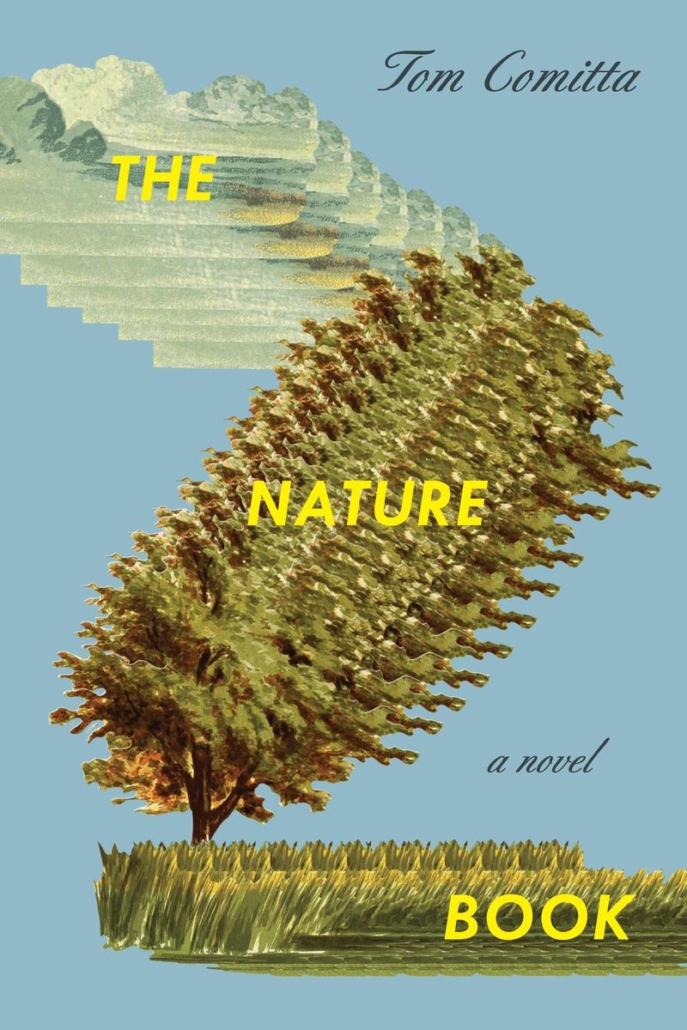
“Bridging the Metabolic Rift with Tom Comitta’s The Nature Book”
 Environmental sociologists have long identified the rise of capitalism with the so-called metabolic rift. This disruption of a sustainable cycle of consumption and production occurs with urbanization and the global redistribution of nutrients and pollutants around centers of human population. After the seismic upheavals of the metabolic rift, high concentrations of waste accumulate, and pre-capitalist routines of renewing the soil, forests, and oceans fall into disarray. To rebalance this unstable situation, John Foster Bellamy, Jason Moore, and others propose a revolutionary reorganization, one that shifts relations of figure and ground. They envision embedding human communities and needs within nature rather than treating nature as a static resource to be plundered for human profit. Dissolving the anthropocentric figure into the ground of nonhuman nature, as it were, becomes the primary formal requirement for an environmentally sustainable future.
 While this conception of ecosocialist transition does not lack critics, it has inspired some intriguing positive responses. In particular, Tom Comitta’s The Nature Book (2023) experiments with the reversal of figure/ground relations. A cut-up comprised solely of descriptions of nonhuman nature drawn from the Anglophone literary canon, Comitta’s work reveals the aesthetic benefits of working within Oulipo-style formal constraints. Their narrative (which more closely resembles conceptual art than a novel) challenges the reader’s capacity for discovering new varieties of ecosocialist pleasure. Through active peripheralization of representations of human figures and their effects, Comitta’s project enlivens readerly encounters with the “ground.” In so doing, it provides training in the cognitive and perceptual skills needed to bridge the metabolic rift. Comitta’s self-styled “supercut” or archive of found language brings to literature some of the benefits of an aesthetics of slowness in other media (most notably, slow cinema). Together, these ecologically minded art forms call into being partial subjects oriented toward a sustainable post-capitalist future.
Professor Caren Irr, Kaiserman Professor in the Humanities at Brandeis, is the author of Towards the Geopolitical Novel: U.S. Fiction in the 21st Century (Columbia 2014), Pink Pirates: Contemporary American Writers and Copywright (Iowa, 2012), the editor of Life in Plastic: Artistic Responses to Petromodernity (Minnesota 2021) and the co-editor of many others, including Minima Moralia in the 21st Century: Fascism, Work, Ecology (Bloomsbury, 2021) and of Rethinking the Frankfurt School (SUNY, 2002) and of On Jameson (SUNY, 2005).
COMMA Talk, 2022-23
Juan Evaristo Valls Boix, Professor of Philosophical Anthropology, the Complutense University of Madrid
“Towards a Vindication of the Right to Laziness from Anarchy to Paradox”
The talk examines the philosophical foundation of the right to laziness, a right that imposes a limit to the capitalist exploitation of bodies and reclaims life that is not governed by merit or economic logic. Strike, laziness, retirement, play or disconnection have been the subject of important philosophical thought (Lafargue, Benjamin, Luxemburg), but only very few studies offer a systematic reflection on the anti-capitalist potential all these tactics share. They need to be defended as rights that may grant an intrinsic value to life, beyond its utility or profit.
Juan Evaristo Valls Boix is Professor of Philosophical Anthropology at the Complutense University of Madrid. He has been Adjunct Professor in Aesthetics and Contemporary Philosophy at the University of Barcelona, and post-doctoral fellow at the University of California, Riverside. He is currently interested in the poetics of inoperosity and the politics of desire within the framework of a critique of neoliberal subjectivity. He is the author of the essays Giorgio Agamben. Política sin obra (Gedisa, 2020) and Metafísica de la pereza (NED Ed., 2022). The title of his current project is The Right to Beautiful Things (forthcoming: Ariel, 2024).
Prof. Glyn-Salton Cox, 1983-2022
In Memoriam
In Memoriam
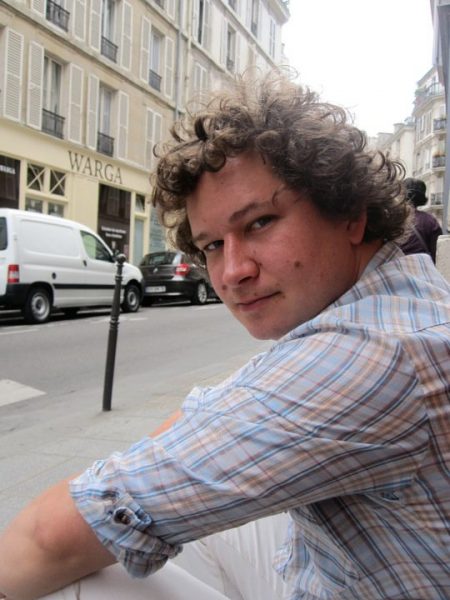
With profound sadness, the COMMA center of the English Dept. at UC Santa Barbara memorializes our esteemed and cherished colleague and friend the late Glyn Salton-Cox, who passed away suddenly and unexpectedly as 2022 ended. Our thoughts are with his wife Beth Sadler, his parents, brother, sister-in-law and extended family in the United Kingdom, and with his many friends on both coasts of the US, in Britain and around the world, as well as his students, past and present. With all of them, we deeply mourn Glyn’s passing.
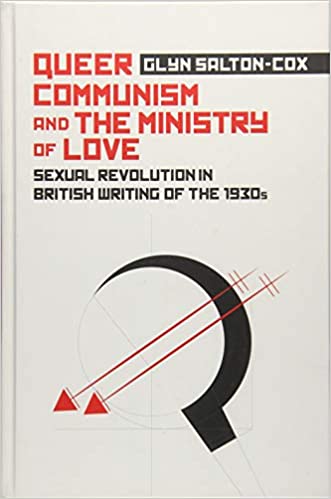
Glyn Salton-Cox came to UC Santa Barbara as an Assistant Professor of English nine years ago, a specialist in twentieth- and twenty-first century literature and culture. He arrived with an already glittering academic record: he earned his BA degree, and then an MPhil. in Criticism and Culture, from Kings College, Cambridge, followed by a PhD in English from Yale. At Cambridge he won the Rylands Prize for top performance in English; at Yale, the English Dept. Prize for the best published essay by a graduate student. At UC Santa Barbara, he soon became affiliated with the Departments of Feminist Studies and with History, suggesting on the one hand, his deep and activist commitment to gender studies, and, second, his scholarly modus of extensive archival research to uncover previously marginalized figures and stories. From the first, he was a mainstay of COMMA, where he memorably presented his own work, and where he could always be counted on for strong arguments, striking readings of the knottiest of theoretical texts, and brilliant insights. With a colleague in Film Studies, in 2016 he co-organized, under the auspices of the IHC, an ambitious conference on one of his own intellectual heroes, the Hungarian Marxist theorist, literary critic and philosopher of aesthetics Georg Lukacs. His first book, Queer Communism and the Ministry of Love: Sexual Revolution in British Writing of the 1930s, was published by Edinburgh University Press in 2018; he was researching and writing his second monograph, on the lumpenproletariat, at the time of his death. Along with a Cambridge colleague, he guest-edited a special issue of Critical Quarterly on ‘The Long 1930’s.’ He has published numerous articles, essays and reviews, and spoken at all of the major conferences in his field on two continents, on topics ranging from the forms of queer communism in 30’s Britain to recent revisionist biographies of George Orwell. At UCSB, he taught graduate seminars on Marxism and queer theory, senior seminars on such topics as ‘Good Comrades and Splendid Creatures: Queer Leftists in Literary Culture,’ and popular undergraduate courses on urban literature, sexual revolutions and twentieth-century prose, and ‘British Comedy and the End of Empire.’ Promoted to Associate Professor in 2019, he directed or was a member of at least ten PhD dissertation committees. Glyn was awarded the English Department Outstanding Graduate Mentor Award in 2017. He was a stalwart member of COMMA, the Center on Modern Literature, Materialism and Aesthetics in the English Dept.
Glyn was a critic and writer of distinction. His academic research, written invariably with his characteristic brio and style, was noteworthy, first, for the joy he took in rediscovering and celebrating writers whose political activism had led to their work being diminished or ignored, and, second, for his explorations of the ways in which sexual revolutions and political revolutions depended on each other and sustained each other. In his own field of 20th. Century Anglophone letters, he worked to bring writers who had been marginalized for their queer sexuality and their radical politics the respect and prominence they deserved; the founding principle of his criticism was that the personal was always political. In his telling, people courageous enough to demand sexual freedom for themselves were the very ones to demand justice on many fronts for everyone. He was proud to have uncovered the political commitments and influences of figures who had often been dismissed even by the British left as mere eccentrics. Hi knowledge of German allowed him to trace complex webs of transmission by which the ideas of radical thinkers in Eastern Europe could reach those in the west, to be remolded by them. Here his archival enthusiasm was crucial, but it was always motivated by his determination to understand how the materialist analysis of social relations matters today. His latest work on the lumpenproletariat promised a major new reading of the cultural and political power of the wretched of the earth.
For all memebrs of COMMA, who have known Glyn for this past decade, his passing leaves a tremendous sense of loss. No one can but believe that here was a brilliant mind with so much more work to be done, ideas to be generated, important works published. Glyn will also be remembered as the kindest, the most convivial and the most generous of colleagues. Whether seated at the long table in the CRC poring over a book in pre-Covid days, explaining the intricacies of a New Left debate about a Grundrisse translation at a COMMA meeting, making clear to his students that in their questioning of gender norms they had his full support, or simply modeling for all of us the pattern and possibilities for a committed, flexible, humorous and open-minded left intellectual in the US university and beyond, Glyn Salton-Cox was a brilliant scholar, a distinctive intellectual, and a writer who has left his own trace upon debates on British twentieth-century culture. A superb voice has been lost to us. We will not see his like again.
COMMA Reading Group, 2021-2022: Bio/Culture/Capital

COMMA Reading Group, 2021-2022: Bio/Culture/Capital


COMMA Reading Group, 2021-2022: Bio/Culture/Capital
Fri., Apr. 8, 2022, Via Zoom
Microsoft Word – COMMA Apr. 8, 2022.docx
You are invited to attend the first meeting of the COMMA Reading Group of Spring 2022:
Date and Time: Friday, April 8th, 3:00-5:00 PM PST via Zoom (link below). We will not meet in-person in the Sankey Room.
Please join our discussion of the following reading:
Kevin Floyd, The Reification of Desire. Toward a Queer Marxism, pp. 1-38 (pdf attached)
Event flier is attached. Please forward to your colleagues. We would be delighted if you join us for the conversation. For meeting details and other questions
contact Andrew Henderson at amhenderson@ucsb.edu
Maurizia Boscagli Director
Andrew Henderson, RA
Reification of Desire: Queer Marxism

COMMA Reading Group 2021-2022: Bio/Culture/Capital
Fri., Oct. 22, 2021, 3-5PM, Sankey Room, 2nd Floor, South Hall, UCSB

COMMA READING GROUP, 2020-21: POSSIBLE FUTURES
During the UCSB Covid Lockdown, COMMA continued with a full schedule of on-line Reading Group meetings.
The year’s theme was: POSSIBLE FUTURES.
Here are the poster announcements for each of the meetings during the academic year 2020-21.


COMMA READING GROUP, 2020-21: POSSIBLE FUTURES
COMMA READING GROUP, 2020-21: POSSIBLE FUTURES
During the UCSB Covid Lockdown, COMMA continued with a full schedule of on-line Reading Group meetings.
The year’s theme was POSSIBLE FUTURES.
Here are the poster announcements for each of the meetings during the academic year 2020-21.

Winter 2020 COMMA Lecture Series, Post-doctoral Fellow Jesse Miller, Friday, February 28th
You are all invited to attend a talk by Jesse Miller, this year’s Postdoctoral Fellow of Literature and Medical Humanities, entitled “Troping the Literary Clinic: Metaphors for Reading in a Therapeutic Culture”.
Friday, February 28th, 3:00-5:00 p.m. in the Sankey Room (South Hall 2623).
Discussion and refreshment to follow. Please join us to support the outstanding work of our English department’s postdoctoral fellow!

Winter 2020 COMMA Reading Group Meets Friday, February 14th
Friday, February 14th, 3:00-5:00 p.m. in the Sankey Room (South Hall 2623).
Frantz Fanon, “Grandeur and Weakness of Spontaneity” from The Wretched of the Earthhttp://home.ku.edu.tr/~mbaker/CSHS503/FrantzFanon.pdf
Michael Hardt and Antonio Negri, “Preface, Life in Common” and selections from Part II, “Multitude” (pp. 99-115, 129-138, 189-190, and 211-219) from Multitude: War and Democracy in the Age of Empire: http://rebels-library.org/files/multitude.pdf
Paolo Virno, “Introduction” from A Grammar of the Multitude: http://www.sduk.us/afterwork/virno_a_grammar_of_the.pdf

Winter 2020 COMMA Reading Group Meets Friday, January 31st
Friday, January 31st, 3:00-5:00 p.m. in the Sankey Room (South Hall 2623).
Please join our discussion of the following readings:
Peter Stallybrass, “Marx and Heterogeneity: Thinking the Lumpenproletariat”
Hal Draper, “The Lumpen-class Versus the Proletariat”

Winter 2020 COMMA Special Event: PARASITE Film Screening
A COMMA Special Event!
Friday, January 17th, 2:00-5:00 p.m. in the Fishbowl (South Hall 2635).
Please join us for a screening of Bong Joon-Ho’s 2019 film Parasite.
The film will be shown at 2:00 p.m., with discussion, food and refreshments to follow.
Don’t miss this exciting event!

Fall 2019 COMMA Reading Group, ECO-MARX, Meets Friday, December 6th
Friday, December 6th, 3:00-5:00 p.m. in the Sankey Room (South Hall 2623).
Please join our discussion of the following readings:
Dimitris Papadopolous, “Insurgent Posthumanism”
Silvia Federici and George Caffentzis, “Commons Against and Beyond Capitalism”

Fall 2019 COMMA Reading Group, ECO-MARX, Meets Friday, November 8th
You are all invited to attend the third meeting of the COMMA Reading Group:
Friday, November 8th, 3:00-5:00 p.m. in the Sankey Room (South Hall 2623).
Please join our discussion of the following readings:
From Friedrich Engels’s Dialectics of Nature:
“Introduction”: https://www.marxists.org/archive/marx/works/1883/don/ch01.htm
“Dialectics”: https://www.marxists.org/archive/marx/works/1883/don/ch02.htm
“Basic Forms of Motion”: https://www.marxists.org/archive/marx/works/1883/don/ch03.htm
“The Measure of Motion–Work”: https://www.marxists.org/archive/marx/works/1883/don/ch04.htm
“The Part Played by Labour in the Transition from Ape to Man”: https://www.marxists.org/archive/marx/works/1876/part-played-labour/index.htm

Fall 2019 COMMA Reading Group, ECO-MARX, Meets Friday, October 25th
Friday, October 25th, 3:00-5:00 p.m. in the Sankey Room (South Hall 2623):
Please join our discussion of the following readings:
John W. Moore, Capitalism in the Web of Life, “Introduction” (12-41): http://geopolitica.iiec.unam.mx/sites/default/files/2019-08/Moore-CapitalismInTheWebOfLife.pdf
John W. Moore (interview with Kamil Ahsan), “Capitalism in the Web of Life”: https://www.viewpointmag.com/2015/09/28/capitalism-in-the-web-of-life-an-interview-with-jason-moore/

Fall 2019 COMMA Reading Group, ECO-MARX, Meets Friday, October 11
Friday, October 11th, 3:00-5:00 p.m. in the Sankey Room (South Hall 2623)
Please join our discussion of the following readings:
John Bellamy Foster, “Marxism and Ecology: Common Fonts of a Great Transition”: https://greattransition.org/publication/marxism-and-ecology
John Bellamy Foster and Brett Clark, “Marx’s Ecology and the Left”: https://monthlyreview.org/2016/06/01/marxs-ecology-and-the-left
John Bellamy Foster, “Marx’s Ecology and the Ecological Revolution,” an interview with Aleix Bombila (optional): https://mronline.org/2010/02/24/marxs-ecology-and-the-ecological-revolution/

COMMA Lecture Series: Ben Etherington
The first COMMA event of the 2019-2020 school year is Friday, October 7th, from 2:00-4:00 p.m. in South Hall 2635 (“the fishbowl”).
Ben Etherington, Associate Professor at the School of Humanities and Communication Arts at Western Sidney University, will give a talk, “WORLD LITERATURE AS A SPECULATIVE TOTALITY: Veselovsky, Auerbach, Said, and the Critical Humanist Tradition”

Thank you for celebrating another great year of COMMA programming for 2018-19!
Thank you to all who joined us on Friday, May 24th to celebrate another great year of COMMA programming!
We honored our talented graduating seniors with many warm wishes and we extended a special, heartfelt congratulations to those who graduated with the undergraduate COMMA major specialization! This year was also the first full year of programming for the student-run undergraduate COMMA reading group that started last Spring when a few passionate undergraduates took the initiative to begin their own COMMA. This group is entirely student run & we are grateful and proud of all the hard work students put into programming and planning!
A thank you to our Center Director, Maurizia Boscagli, & the 2018-19 Center RA, Christine Weidner
~Stay tuned for more COMMA starting in the Fall when we welcome the incoming COMMA RA, William Collins~


Celebrating the graduating seniors & a great year of COMMA programming 2018-19!
Thank you to all those who joined us on Friday, May 24th, to celebrate a great year of COMMA programming during this academic year! With warm wishes and many congratulations we were able to honor the UCSB seniors graduating with the COMMA major specialization. Alongside their peers, this talented group of undergraduates helped develop an undergraduate COMMA reading group programmed entirely by the undergraduates themselves. Bravo! We thank them, as well as Center Director Maurizia Boscagli & Center RA Christine Weidner, for their hard work as this group continues to grow.
Stay tuned for the next year of COMMA programming with COMMA’s new RA, William Collins!

Undergraduate COMMA Major Specialization 2018-19
Join COMMA Friday, 4/26, to discuss “Geocommunism” & “Marx’s Ecology
Join COMMA this Friday, April 26th, at 3pm in the Sankey Room (South Hall 2623) in our ongoing series The Dialectic Plus as we discuss the two texts below:
1) Arun Saldanha, “Geocommunism: Is There Life after Man?” (from Posthumous Life: Theorizing Beyond the Posthuman, Claire Colebrook et al, eds.)
2) Brett Clark & John Bellamy Foster’s, “Marx’s Ecology in the 21st Century”
Join us Friday, 3pm in the Sankey Room for good snacks and discussion!

First COMMA meeting of Spring is (4/12) : Haraway & Agamben
Join COMMA in the Sankey Room (SH 2623) at 3pm on Friday, April 12th to discuss the following readings:
We will discuss two pieces from Biopolitics: A Reader :
1) Giorgio Agamben, “The Politicization of Life” (Chapter 6)
2) Donna Haraway, “The Biopolitics of Postmodern Bodies: Constitutions of Self in Immune System Discourse” (Chapter 14)

*click here for the web hyperlink: Biopolitics: A Reader (eds. Campbell & Sitze)


First COMMA meeting of Winter 2019 quarter is Friday, Jan 18th

The first COMMA meting of the Winter quarter is this FRIDAY, Jan 18th, at 3pm in the Sankey Room (South Hall 2623).
In this ongoing Dialectic Plus series we will discuss:
1) “A Dialectic Approach to Film Form” by Sergei Eisenstein linked here.
2) Ch. 1 “Separation Perfected” from Guy Debord’s Society of the Spectacle linked here.
3) “The Culture Industry” by Adorno & Horkheimer linked here.
Come Friday, 3pm for food and good discussion – all are welcome!
Fifth COMMA meeting of the Fall quarter, 11/30

Fourth COMMA meeting of the quarter, 11/16

You are invited to the Fourth Fall COMMA meeting later today:
Marx, “Theses on Feuerbach” (www.marxists.org/theses)
Cyril Smith, “Science and Humanity: Hegel, Marx, and Dialectic” (www.marxists.org/smith)
Yannis Varoufakis, “Marx Predicted Our Present Crisis and Points the Way Out”
Please join us
Friday, November 16th
3:00-5:00pm
South Hall 2623, The Sankey Room
COMMA meeting Fri. Nov 2nd, 3pm

Second COMMA meeting of Fall Quarter, Fri., Oct. 19, 3pm

COMMA 2018-2019 Opening Meeting, 10/5, THE DIALECTIC PLUS

Marxism in Reverse – Reading Group

Marxism in Reverse – Lecture Series

Marxism in Reverse – Lecture Series

Marxism in Reverse – Reading Group

Marxism in Reverse – Reading Group
 Welcome back to the first COMMA meeting of Spring quarter.
Marxism in Reverse – Lecture Series

Marxism In Reverse – Reading Group
 COMMA Reading Group
Marxism in Reverse – Visiting Speaker

Marxism in Reverse – Reading Group

Friday February 2, 3:00pm in South Hall, the Sankey Room.
Marxism in Reverse – Talk

Marxism in Reverse – Film Screening

Film screening:_Rachida_, (Yamina Bachir-Chouikh dir., Algeria, 2002)Friday December 8th, 12:30
South Hall 2635
(please note the new time and place of our meeting)
The film will be introduced by Professor Bernadette Andrea, English Department.
Bachir-Chouikh’s work will take the discussion of gendered nationalism, which we started with our reading of Fanon, to two different moments of Algerian history: the contemporary time, and the time of the Algerian War of Independence (1954-1962). We recommend you watch beforehand Gillo Pontecorvo’s film _The Battle of Algiers_ (1966). Pontecorvo’s film stream on Youtube or can be watched on Amazon. Here are the links to an analysis of Bachir-Chouikh’s film ([http:/www.aljadid.com/content/womans-struggle-midst-war]http:/www.aljadid.com/content/womans-struggle-midst-war) and Pontecorvo’s (https://www.opendemocracy.net/mani-sharpe/gender-myth-nationalism-gillo-pontecorvos-battle-of-algiers).
We hope to see you there!
Maurizia Boscagli, Director
Leah Norris, RA
Marxism in Reverse – First Talk

Marxism in Reverse – Third Reading Group

Marxism in Reverse – Second Reading Group

Marxism in Reverse – First Reading Group

Film Screening of Jessica Hausner’s “Lourdes” (2009)

Please join us for COMMA’s next event of the 2016-17 series, Modernist Energies, with a screening of Jessica Hausner’s Lourdes (2009) on Friday, May 5th at 1:00 in South Hall 2714.
Lourdes is a sober film shot through with miracles, hope, and events inexplicable to the modern sensibility. Sylvie Testud stars as Christine, a reluctant pilgrim to the famous Catholic shrine who, despite her lack of faith, seems to have her multiple sclerosis miraculously cured. Lourdes won the Vienna Film Prize for best film. The screening will be followed by discussion and pizza will be served.
Reading Group Meeting for “An American Utopia” by Fredric Jameson
 On Friday, April 21st we will be meeting in South Hall 2623 to discuss the Fredric Jameson’s “An American Utopia.”
“Fredric Jameson’s pathbreaking essay “An American Utopia” radically questions standard leftist notions of what constitutes an emancipated society. Advocated here are—among other things—universal conscription, the full acknowledgment of envy and resentment as a fundamental challenge to any communist society, and the acceptance that the division between work and leisure cannot be overcome. To create a new world, we must first change the way we envision the world. Jameson’s text is ideally placed to trigger a debate on the alternatives to global capitalism. In addition to Jameson’s essay, the volume includes responses from philosophers and political and cultural analysts, as well as an epilogue from Jameson himself.
Many will be appalled at what they will encounter in these pages—there will be blood! But perhaps one has to spill such (ideological) blood to give the Left a chance.” (Verso)
PDF is available in the Collaborative Research Commons in South Hall or by emailing Chris Walker (caw2105 at gmail dot com).
“T. S. Eliot and the Dynamic Imagination,” a talk by Dr. Sarah Kennedy (Cambridge)

Continuing our series on “Modernist Energies,” COMMA is pleased to announce the first event in our Spring calendar. Dr. Sarah Kennedy (Cambridge) we deliver a talk from her forthcoming book, T. S. Eliot and the Dynamic Imagination (Cambridge UP, 2017) on Monday, April 10th at 3:00 in South Hall 2623 (Sankey).
“T.S. Eliot and the Dynamic Imagination” considers Eliot’s poetic rendering of light through the evolving medium of the eye. The eye became for Eliot an increasingly contested symbol of empirical vision and its opposite, the inner vision, which may or may not reveal the “truth” the eye conceals. Charting Eliot’s engagement with the science of optics and color perception, the analysis extends from the eye to vision (in parallel with the poetic movement from depictions of the physical eye to psychological symbols of inner vision). It considers Eliot’s wavering between imagining the universal aspect of vision (he once wrote that “Speech varies, but our eyes are all the same”), and an awareness of the propensity for vision to play tricks with the specters and shadows of its own casting.
Dr Sarah Kennedy is a Research Fellow in English at Downing College, Cambridge, specializing in modernist and contemporary Anglophone poetry. Her research interests include metaphor, landscape, and literary selves.
As always, refreshments will be provided! We hope to see you there.
Image: Umberto Boccioni, “The City Rises” (1910).
Film Screening of Yorgos Lanthimos’s “The Lobster” (2015)

Yorgos Lanthimos’s dystopian comedy centers on the frantic search for love and meaning in a strictly hierarchized world in which failure to find companionship results in exclusion from the human species. Colin Farrell and Rachel Weisz star as outcasts, living on the fringes of society to avoid capture and to discover alternatives to state-sanctioned romance. The Lobster won the Jury Prize at Cannes Film Festival and was nominated for Best Original Screenplay at the Academy Awards. The screening will be followed by discussion.
As always, Pizza and drinks will be provided, so come hungry!
Reading Group Meeting for “Dying Modern”

On Friday, February 17th we will be meeting in South Hall 2623 to discuss the Diana Fuss’s Dying Modern: A Meditation on Elegy (2013).
“In Dying Modern, one of our foremost literary critics inspires new ways to read, write, and talk about poetry. Diana Fuss does so by identifying three distinct but largely unrecognized voices within the well-studied genre of the elegy: the dying voice, the reviving voice, and the surviving voice. Through her deft readings of modern poetry, Fuss unveils the dramatic within the elegiac: the dying diva who relishes a great deathbed scene, the speaking corpse who fancies a good haunting, and the departing lover who delights in a dramatic exit.
Focusing primarily on American and British poetry written during the past two centuries, Fuss maintains that poetry can still offer genuine ethical compensation, even for the deep wounds and shocking banalities of modern death. As dying, loss, and grief become ever more thoroughly obscured from public view, the dead start chattering away in verse. Through bold, original interpretations of little-known works, as well as canonical poems by writers such as Emily Dickinson, Randall Jarrell, Elizabeth Bishop, Richard Wright, and Sylvia Plath, Fuss explores modern poetry’s fascination with pre- and postmortem speech, pondering the literary desire to make death speak in the face of its cultural silencing..” (Duke University Press)
PDF is available in the Collaborative Research Commons in South Hall or by emailing Chris Walker (caw2105@gmail.com).
Film Screening of Yung Chang’s “Up the Yangtze” (2007)

Please join us for COMMA’s next event of the 2016-17 series, “Modernist Energies.” We will be screening Yung Chang’s Up the Yangtze (2007) on Friday, Jan. 27th at 1:00 in South Hall 2635.
Friday, January 27th at 1:00 in South Hall 2635Yung Chang’s first full length film documents the hope and despair attending the construction of the Three Gorges Dam, the world’s largest power station. The project, a central component of the infrastructure boom fueling China’s advance in the world economy, displaced over 1 million people and submerged important archeological sites, even as it provided significant access to power for an entire province. The Dam likewise signaled a shift from rural agriculture to a new relation between the rural hinterlands and the metropole. Up the Yangtze offers a sobering account of the cost of high energy capitalism and takes place at the center of contemporary debates about social, economic, and environmental justice.
As always, pizza and drinks will be provided!
“Proletarian Modernism in the Long 1930’s,” a talk by Professor Benjamin Kholmann (University of Freiburg)

Please join us for another talk for COMMA’s 2016-17 series, “Modernist Energies.” We continue the year with a talk by Professor Benjamin Kholmann on Tuesday, November 22nd at 3:00 in the Sankey Room (SH 2623).
Professor Kholmann is Assistant Professor at the University of Freiburg. He is author of Committed Styles: Modernism, Politics, and Left-Wing Literature in the 1930s (Oxford UP, 2014) which cuts against the long-standing tradition of an apolitical modernism to offer a novel reading of modernism of the 1930s as highly political. Professor Kholmann has also edited several volumes, including the forthcoming A History of 1930s British Literature (Cambridge UP); a special issue of Literature and History on Literatures of Anti-Communism (Spring 2015); Edward Upward and the Left-Wing Literary Culture in Britain (Ashgate 2013); and, Utopian Spaces of Modernism: British Literature and Culture 1885-1945 (Palgrave 2012).
Professor Kholmann will deliver a talk entitled “Proletarian Modernism in the Long 1930’s.” This paper identifies a modality of modernist writing that he calls “proletarian modernism”. The writing subsumed under this label is significant for several reasons. First, it usefully defamiliarizes the popular notion of “late modernism” by highlighting an alternative route taken by interwar writing: proletarian modernists, he suggests, aimed at a retooling of modernism, opening up new futures for modernism rather than anticipating its end. Second, proletarian modernism effected a wide-ranging politicization of modernist formal experiment: in works of proletarian modernism, the question of what a properly classless aesthetic looks like is inseparably bound up with the vision of a genuinely classless society. Proletarian modernism thus reopens the question of modernism’s political valences by asking us to think about modernism in proletarian terms; at the same time, it requires us to think about the proletarian aesthetic not in relation to some content (writing which is by and about the working class) but in more specifically formal (or aesthetic) terms.
“Conjectures on World Energy Literature,” a talk by Professor Imre Szeman (University of Alberta)

Please join us for COMMA’s first event of the 2016-17 series, “Modernist Energies.” We begin the year with a talk by Professor Imre Szeman on Thursday, November 10th at 3:00 in the Sankey Room (SH 2623).
Professor Imre Szeman is Professor and Canada Research Chair in Cultural Studies in the Department of English and Film Studies at University of Alberta. In addition to editing Cultural Theory: An Anthology (2010) and The Johns Hopkins Guide to Literary Theory and Criticism (2nd Ed., 2005), Professor Szeman is author of Zones of Instability: Literature, Postcolonialism and the Nation (JHU 2003) and After Globalization (2011) with Eric Cazdyn. His current work spans the politics of cultural theory to the cultural politics of oil, entitled On Empty: The Cultural Politics of Oil. In addition to these monographs, Szeman is also the co-director of the Petrocultures Research Group and director of the collaborative group research project, After Oil: Explorations and Experiments in the Future of Energy, Culture and Society.
Professor Szeman will deliver a talk entitled “Conjectures on World Energy Literature”
Film Screening of Dziga Vertov’s “Enthusiasm” (1931)

Please join us for the first event in our 2016-17 series, “Modernist Energies.” On Friday, Oct. 28th at 12:00 in SH 2635 we will screen Dziga Vertov’s 1931 film, Enthusiasm. Vertov’s first sound film tracks the efforts of Ukrainian miners in the Donbass coal mines to fulfill their part of the first five-year plan in only four years. Following the screening, there will be a discussion of the film and two essays by Jonathan Beller and Sergei Tret’iakov (copies available in the CRC). As always, pizza and drinks will be provided!
“A Shade or a Shape of You: Theory of Mind in Lily Briscoe’s Vision,” a talk by Professor Sowon Park (English, UCSB)

The Literature and the Mind Initiative will host its Inaugural Talk on Monday, October 24th at 5:30 in South Hall 2635. Professor Sowon Park (UCSB, English) will deliver a lecture on Theory of Mind in To the Lighthouse that will be of great interest to all COMMA members.
Professor Sowon Park specializes in British Modernism, Political Fiction, World Literature, and the relationship between Literature and other forms of knowledge, in particular Cognitive Neuroscience. Before coming to UCSB, she taught at Oxford University for over a decade, where she was Lecturer and Tutor in English at Corpus Christi College. Her previous academic appointments were at Cambridge University and Ewha University, Seoul. She has also held visiting appointments at UCSD and ZFL, Geisteswissenschaftliche Zentren, Berlin. She received an M.Phil and D.Phil in English from Oxford. Recently, she was awarded a four-year AHRC grant to work on “Prismatic Translation’. Her latest publication is a special issue of The Journal of World Literaturethat she guest-edited, titled, The Chinese Scriptworld and World Literature (June, 2016). She has published her academic work in The Review of English Studies, MLQ, ELT, European Review, Arcadia,Neohelicon and Comparative Critical Studies.
“A Shade or a Shape of You: Theory of Mind in Lily Briscoe’s Vision”:
In the last fifteen years, “Theory of Mind (ToM)” has been the object of intense investigation in developmental psychology, cognitive neuroscience, anthropogeny, philosophy and literary studies, producing a number of related concepts to develop our understanding of how we impute mental states to ourselves and others. The first part of the paper will provide a brief overview of current research and consider issues that emerge when these terms are translated across disciplines. The second part will discuss relevant findings in ToM research in neuroscience and bring them to bear on the private vision of Lily Briscoe in To the Lighthouse. The aim of the paper is to reflect on what ToM might mean for literary research that makes it distinct from other lines of inquiry and to consider Intersubjectivity from a ToM angle.
Professor Christopher Prendergast’s public lecture “Culture, Politics & Comparative Philology in the Nineteenth Century”

UCSB’s Graduate Center for Literary Research will host Professor Christopher Pendergast as the Distinguished Visiting Professor for 2016-2017. Prendergast is Emeritus Professor at the University of Cambridge and a Fellow of King’s College. He was formerly Distinguished Professor in French and Comparative Literature at the Graduate Center, City University of New York.
His visit will feature two events open to the public:
1) A public lecture on Thursday, Oct. 20th, 5-7 at Mosher Alumni House:
“Culture, Politics & Comparative Philology in the Nineteenth Century”
The harnessing of the developing discipline of comparative philology to various agendas centered on ethnicity, nation and race is well-known as one of the key junction points at which nineteenth-century intellectual and academic history connected with political ideology. Christopher Prendergast returns to that scene, but in order to bring into the foreground that yoking of the study of language to politics. He does so principally by way of the key figure of Michel Bréal, the first Professor of Comparative Grammar at the Collège de France.
2) A Graduate seminar on Wednesday, Oct. 19th, 4-6 at Phelps 6206C:
“History and Periodization: The Invention of the Century”
One of the basic organizing principles of historical study is the division of historical time into units and periods, so basic indeed as to be effectively taken as a kind of intellectual second nature. On the other hand, historical periodization of history has its own history (as well as cross-cultural variations). Professor Prendergast takes the practice of ordering time into units of 100 years and discusses when, how and why this came about, focusing in particular on the history of the French term ‘siècle’.
COMMA’s 2016-17 Organizational Meeting will be held Thursday, Oct. 20th

Please join us for COMMA’s first meeting of the year on Thursday, Oct. 20th from 3:30-4:30 in South Hall 2617 (the Sankey Room). At the mixer we will discuss programing for the year including upcoming speakers, the film series, and reading group. Wine and snacks will be served.
British Art from Whistler to World War II

From September 18, 2016 through January 8, 2016, the Santa Barbara Museum will host an exhibit of British art from 1890-1945. In conjunction with the exhibit, COMMA will host a series of events and with the generous support of an Arnhold Collaborative Research grant will develop project connecting faculty, graduate and undergraduate student researchers. Details on events and the project will be coming soon. If you would like to learn more British Art from Whistler to World War II, you can find it here.
COMMA’s 2016-17 Program: “Modernist Energies”

“Lightening Fields” (2008), by Hiroshi Sugimoto.
In 2016-17, COMMA will host a program of speakers, films, and reading groups centered on Modernist Energies.
Film Screening of George Miller’s “Mad Max 2: The Road Warrior” (1981)

Please join COMMA for the final meeting in our 2015-16 series, “In The Desert of the Real” with a screening of the second film in George Miller’s Mad Max series. Set in a post-apocalyptic desert landscape, the film interweaves themes of war, energy, resource scarcity, and environmental justice. The screening will be followed by discussion, and pizza will be provided.
“From Craft to Art: Communicating Through the Medium of Book Art,” a talk by Book Artist Lyall Harris

Please join us for COMMA’s next event in our year-long series, “The Desert of the Real.” Award-winning book artist Lyall Harris will be presenting “From Craft to Art: Communicating Through the Medium of Book Art” on Thursday, May 5th at 3:00. This event, hosted in conjunction with UCSB Special Collections, will be held in UCSB Library’s Special Collections Conference room (3rd Floor of Davidson Library) with a reception immediately to follow.
Since the late 90s, Lyall Harris’ artwork has been exhibited in more than one hundred solo and juried group shows and recognized with over twenty awards, including The George Hitchcock Prize for painting from the National Academy Museum, NY, and a Purchase Award in Book Art from the University of Utah for a fifteen-book site-specific project. Her book art can be found in numerous Special Collection libraries across the United States, among these, Yale (Haas Arts Library), Stanford (Green Library), Indiana University (Lilly Library), Davidson Library (UCSB) and Smith College (Mortimer Rare Book Room). Harris has been the recipient of fellowships at Virginia Center for the Creative Arts, NALL Foundation in Vence, France, and San Francisco’s Grabhorn Institute.
“From Craft to Art; Communicating Through the Medium of Book Art”
Book art at its best is a medium where the maker’s keen use of the material components creates a faceted, more comprehensive and potent language to express content. In this way, the parts themselves, in the context of the piece, become bearers of meaning that work collectively to cause a kind of “transcendence,” from material to conceptual. This is where craft becomes art. Lyall Harris will present an array of these “literary art objects”—variously spawned by particular texts, “book” forms, specific materials, or images—to illustrate my creative process and the unique potential of book art as medium.
“Getting Real About the Anthropocene,” a talk by E. Ann Kaplan (Stony Brook University)

Please join us for COMMA’s next event of the Spring Quarter. We will continue our investigation of “The Desert of the Real” on April 15th at 1:00 in South Hall 2623 with a talk by E. Ann Kaplan.
Professor Kaplan is Distinguished Professor of English, and Cultural Analysis and Theory, at Stony Brook University. Her influential works on feminist film theory include Women & Film: Both Sides of the Camera (1990) and Motherhood and Representation (1992). Professor Kaplan’s work on trauma theory includes Trauma Culture: The Politics of Terror and Loss in Media and Literature (2005), and has led her to her current research considering the physic structures of human/environmental relations. In 2015, Rugters published her most recent monograph, Climate Trauma: Foreseeing the Future in Dystopian Film and Fiction.
“’Getting Real About the Anthropocene’: Pretrauma and Cultural Politics in Futurist Dystopian Film (with Reference to Jeff Nicol’sTake Shelter)”
In this talk, taken from her 2015 monograph, Climate Trauma: Foreseeing the Future in Dystopian Film and Fiction, E. Ann Kaplanexplores how cinema negotiates the catastrophe of climate change humans ignore at their peril. She first asks what affects and psychic processes prevent humans from coming together to save the planet. In turning to dystopian narratives to investigate such questions, Kaplan develops the concept of pre-traumatic stress (linked to the familiar Post-Traumatic Stress Syndrome), and asks what impact results from viewers occupying a position of “virtual future humans” in climate disaster fictions. Here, Take Shelter will be discussed as a striking example of pre-traumatic stress. Second, Kaplan attends to the cultural politics in disaster scenarios commenting on meanings attached to race and gender; she introduces psychoanalysis to partially explain the evident sexism and racism. Finally, Kaplan debates whether or not commercial climate disaster films provide an unhelpful sense of mastery, collude with corporate manipulation of fear, or function as a call to action. Film can be a powerful tool for changing consciousness and even policy. She concludes that if we can understand the psychic processes involved in climate denial, we have a chance to rupture the ideological structures that entrap people.
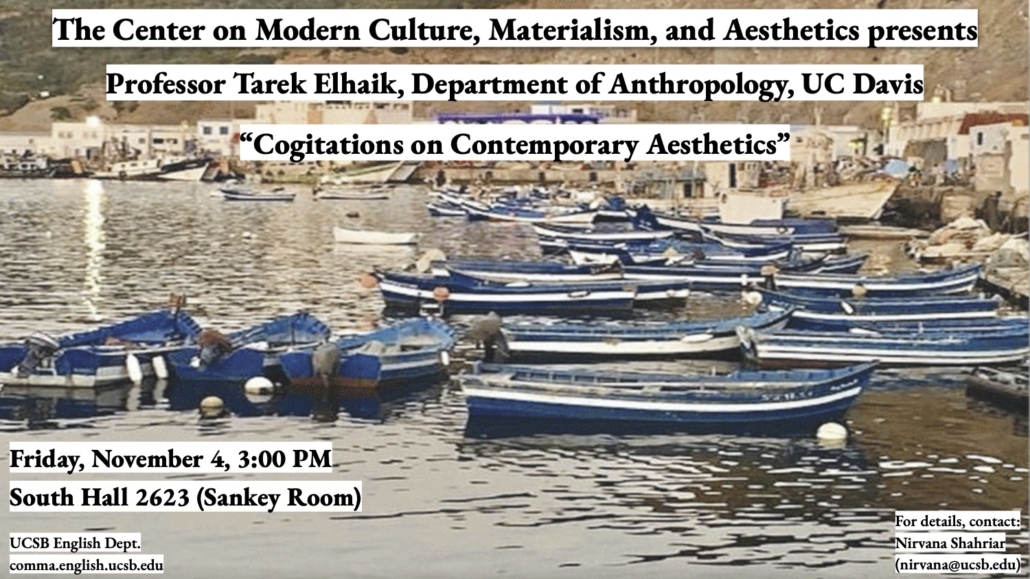
“Red Deserts: a Color Without Substance,” a talk by Professor Tarek Elhaik (UC Davis)

Please join us for COMMA’s first event of the Winter Quarter. We will continue our investigation of “The Desert of the Real” on Friday, April 8th at 1:00 in South Hall 2623 with a talk by Tarek Elhaik. Professor Elhaik is Assistant Professor of Anthropology at the University of California, Davis, where he also runs and curates AIL (the Anthropology of the Image Lab). He has published articles in various journals and anthologies, and is the author of The Incurable Image: Curating Post-Mexican Film & Media Arts (Edimburgh University Press, February 2016). As always, snacks and drinks will be provided.
This talk stems from a series of encounters with artists whose “Earth” is grounded in what Elhaik calls a “geo-curation.” Among these artists is Michelangelo Antonioni whose 1964 classic Technicolor filmRed Desert will as our point of departure. By combining anthropological theories of color (Taussig, 2009; Levi-Strauss, 1964) and Deleuze’s meditation on Antonioni’s “geophysics,” the talk remediates and reconfigures Earth as an enduring form and “incurable-image” (Elhaik, 2016) of the so-called Anthropocene. By assembling images from Red Desert alongside those of Robert Smithson’s earthwork Spiral Jetty (1970) and Tareq Teguia’s film Inland (2008) Antonioni’s geo-curation emerges as a human practice that inhabits the world as a desert without a substance.
Suggested readings for the talk include:
Deleuze, Gilles. “On The Time-Image” in Negotiations (New York: Columbia U. Press) p. 57-61.
Elhaik, Tarek. “Rome-Algiers-Bahia: A Bloc of Sensation In Lieu of Geography” in in Sweet Sixties: Specters and Spirits of a Parallel Avant-garde. Georg Schöllhammer & Ruben Arevshatyan eds. Sternberg Press (2014): 217-228. (Attached)
Taussig, Michael. What Color is the Sacred? (Chicago: University of Chicago Press, 2009), p. 3-12
Levi-Strauss, Claude. The Raw and the Cooked. (London: Jonathan Cape, 1970 [1964]), p. 18-20
Film Screening of Nacer Khemir’s “Wanderers of the Desert” (1984)

Please join COMMA as we continue our 2015-16 series, “In The Desert of the Real” with a screening of the first film in Nacer Khemir’s “Desert Trilogy.” Set in a small town on the edge of an immense desert, Wanderers of the Desert (1984) interweaves myth and dream in order to explore tensions between modern and traditional values. The screening will be held on Friday, Feb. 12th at 1:00 in SH 2635 and, as always, the will be followed by discussion, and pizza will be provided.
Film Screening of Abderrahmane Sissako’s “Timbuktu” (2014)

Please join us on Friday, Feb. 26th at 1:00 in SH 2635 as COMMA continues the 2015-16 series, “In the Desert of the Real” with a screening of Abderrahmane Sissako’s award winning film, Timbuktu (2014). Inspired by a public execution, Sissako’s film offers a gritty exploration of cultural conflict resulting from the occupation of Timbuktu by a jihadist faction. As always, we will reserve time after the film for discussion and pizza will be provided.
Film Screening of Michelangelo Antonioni’s “Red Desert” (1964)

Please join us for the first event in COMMA‘s winter schedule on Friday, Jan. 15th at 1:00 in South Hall 2635. We will be screening Michelangelo Antonioni’s Red Desert (1964). Following the screening, Eileen Joy (UCSB) will join us to discuss the film and her article “Blue” from the important collection, Prismatic Ecologies (2013). Copies of “Blue” are available in the CRC. As always, refreshments will be provided.
“The Desert on the Doorstep,” a talk by Professor Dick Hebdige (UCSB)

Please join us this Friday, Nov. 6th 1:00 in South Hall 2623 (the Sankey Room) for a talk by Dick Hebdige (UCSB, Film & Media Studies) entitled “The Desert on the Doorstep.”Professor Hebdige is the author of several important monographs including Subculture: The Meaning of Style (1979) and Cut ‘n’ Mix: Culture, Identity and Caribbean Music (1987). The talk will draw upon research conducted through the “Desert Studies Project” (2007-15) run under the aegis of the UC Institute for Research in the Arts.
Figured simultaneously as eternally remote yet all too close to home, the Desert in the era of intensifying crisis in the Middle East and the longest drought in California’s recorded rainfall history refuses to stay put. The deserts east of LA, easily accessed via the arterial sprawl of Interstate -10 serve as home to a growing number of permanent Inland Empire residents and as weekend getaway destinations for second homesteaders, tourists, off-road vehicle enthusiasts, Burners and boulderers alike. Hubs for agribusiness, the military-industrial complex, the casino, resort and waste disposal industries, the desert hinterlands form the literally overlooked outer- rim components of trans-nationally networked metropolitan ecologies. Drawing on the archive of the Desert Studies project a UC system wide interdisciplinary arts-centered research initiative centered in southern California’s arid zone this talk addresses the desert’s problematic placement within the imaginary of 21st century West.
Film screening of Werner Herzog’s “Where the Green Ants Dream” (1984)

Friday, Oct. 16th at 1:00 in SH 2635 Please join us as we open our 2015-16 series, “In The Desert of the Real” with a screening Werner Herzog’s first film in English. The screening and discussion will be held onFriday, Oct. 16th at 1:00 in SH 2635. Set in the Australian desert, Where the Green Ants Dream (1984) stages a confrontation between environmental activism and modernization as local Aborigines fight a mining company searching for uranium mining sites. Blending documentary and feature film, Herzog explores the legal and philosophical issues behind neocolonialism and the extraction of local resources. The screening will be followed by discussion, and food will be provided.
COMMA’s 2015-16 Theme: “The Desert of the Real”

Human Programming

Human Programming: Brainwashing, Automatons, and American Unfreedom (2016), by Scott Selisker.
Hope at Sea

Hope at Sea: Possible Ecologies in Oceanic Literature (2015), by Teresa Shewry.
Stuff Theory

Stuff Theory: Everyday Objects, Radical Materialism (2014), by Maurizia Boscagli.
The Speed Handbook

The Speed Handbook: Velocity, Pleasure, Modernism (2009), by Enda Duffy.
Sublime Noise

Sublime Noise: Musical Culture and the Modernist Writer (2014), by Josh Epstein.
Global Icons

Global Icons: Apertures to the Popular (2011), By Bishnupriya Ghosh.
Apocalyptic Futures

Apocalyptic Futures: Marked Bodies and the Violence of the Text in Kafka, Conrad, and Coetzee (2011), by Russell Samolsky.
Tactical Media

Tactical Media (2009), by Rita Raley.
Hello
Hello